
REVIEW · CITY TOURS
Bucharest City Tour 2 hours – by Car with a Private Guide
Big symbols of Romania, from car windows. This 2-hour private tour gives you a fast, guided way to understand what shaped modern Bucharest, from communist power to everyday Romanian traditions. I like that the route is built around major landmarks, not random stops, so you get meaning even if you are short on time.
Two things I really value are the licensed English-speaking guide/driver who stays with you for the full tour, and the fact that it is set up so you do not have to think about car costs. Gas, parking, and road tolls, plus taxes, are included, which makes the price feel straightforward.
One consideration: this is a car-based overview, so you will mostly see buildings and museum spaces from a visitor viewpoint, not at a slow pace. If you want long, inside-only time in every stop, you may feel time pressure in just two hours.
Key highlights you can actually plan around
- Private group, private car: just your party, with a guide/driver in the vehicle.
- All car expenses included: taxes, parking, tolls, and gas are covered.
- Communism to Revolution storyline: stops tied to Ceaușescu and December 1989.
- National Village Museum stop: a one-location snapshot of Romanian traditional homes.
- Arc of Triumph exhibits may be available: you might be able to see four themed displays.
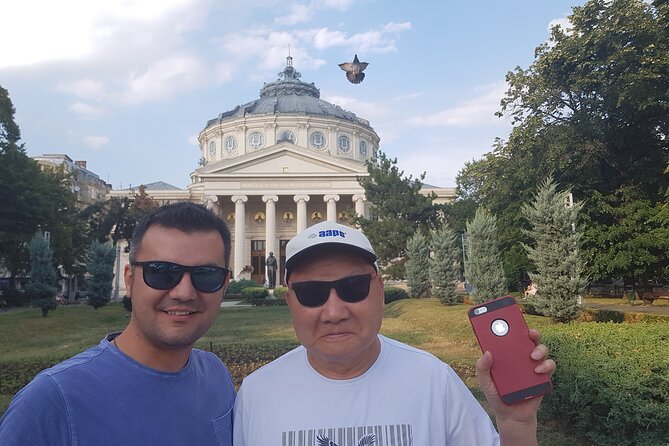
- Photo-friendly cultural center: Athenaeum and the surrounding historic core.
Elsewhere in Bucharest, and up the valley
- Bucharest: Dracula’s Castle, Peles Castle, & Brasov Old Town★ 4.5 · 17,858 reviews
- Bucharest: Dracula Castle, Peles Castle & Brasov Old Town★ 4.6 · 10,891 reviews
- Bucharest: Dracula’s Castle, Peleș Castle & Brașov Day Trip★ 4.5 · 5,919 reviews
- Bucharest: Palace of Parliament Tickets and Guide★ 4.3 · 3,182 reviews
Why a private 2-hour drive works for first-timers in Bucharest
Bucharest can feel like a city of big statements. This tour is designed for that, using a private car and an English-speaking guide/driver so you spend more time learning and less time figuring out where to go next.
The big win is pacing. In about two hours, you cover multiple eras, which is hard to do if you are trying to stitch together stops on your own. You also get flexibility, meaning changes to the daily itinerary can be made even after the tour starts, which is useful if traffic or timing shifts.
This is also a good option if your group has mixed interests. Some people want the political history, others want architecture and culture. With this route, you get both, without turning the day into a marathon.
The big starting stop: Palace of Parliament and People’s House
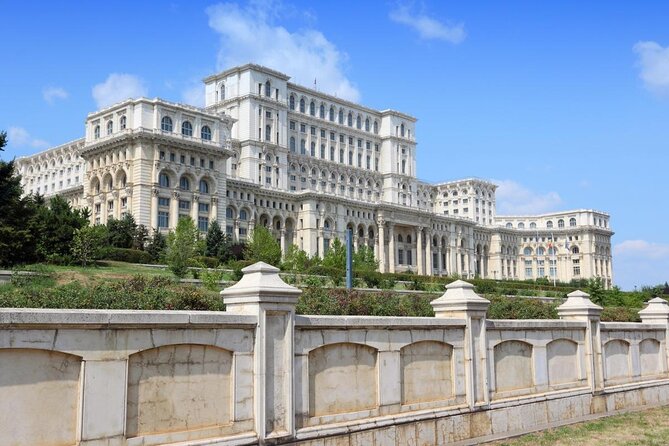
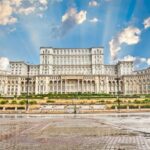
Your first major stop is the Palace of Parliament, also known historically as the People’s House. The message here is not subtle. You learn how dangerous and damaging a totalitarian regime like communism can be for a nation, and you get a sense of what pointless opulence and megalomania can look like in stone.
You also get scale. This building is described as the second-largest administrative building on the planet, after the Pentagon. Even if you are not usually into architectural superlatives, the size helps you understand why this stop is so central to the story of Romania’s modern era.
If you are the kind of visitor who likes connecting places to consequences, this stop does that. It frames the rest of the tour, so later sites about power, revolution, and collapse land with more context.
National Village Museum: Romanian traditions, homes, and sustainable thinking
Next comes the National Village Museum, where the idea is “one place, many regions.” You see Romanian traditional homes and how they were built, including wooden and adobe structures, plus stone and other materials depending on where they come from.
What I find most useful here is the guide’s framing of lifestyle. This stop is presented as an embodiment of Romanian traditions, and it highlights what it meant for villagers to create an ecological and sustainable environment in their backyard. That is a different lens than the usual museum approach, which often separates culture from the practical ways people lived.
You also get a glimpse into daily life described as simple and modest, with people living in social and spiritual harmony with their surroundings. It is the kind of stop that makes you rethink what “heritage” means. It is not just costumes and crafts, it is the way a community shaped its home environment over time.
Following the Revolution trail: Ceaușescu ouster and the Senate Palace setting
A private tour like this works especially well when the itinerary tells a single story. After the village museum, the focus shifts back into the political timeline, centered on Nicolae Ceausescu and the December 1989 Revolution.
You hear about his ousting and the aftermath, including references to secrets of a great fortune and controversies tied to the state security service and offshore accounts. Then the route moves to the Senate Palace, a building used to house the Central Committee of the Romanian Communist Party and described as a key place where the Revolution of December 1989 started.
Even if you are not fully fluent in the details, seeing the physical settings helps. You are not only hearing about events, you are standing near the structures that shaped how people experienced power, and how that power was challenged.
Other guided days in Bucharest
Ceaușescu Mansion: a private residence turned into historical clue
Another stop on the political thread is the Ceaușescu Mansion. The tour frames it as the private residence of Nicolae and Elena Ceaușescu for a quarter of a century, from 1965 to 1989, along with their children, Nicu, Zoia, and Valentin.
This is one of those places that changes the tone of a conversation. Once you have seen the scale of the grand administrative building, you then move to the personal side of power. The contrast helps you understand how authoritarian regimes often operate, not just through institutions, but through private comfort and family control.
For a lot of visitors, this is where the tour becomes more human. You start noticing how the same system shows up in multiple forms, public buildings and private spaces.
Arc of Triumph, 27 meters up, with four exhibits you may catch
Next you reach the Arc of Triumph, described as measuring 27 meters in height. You also get a helpful comparison: about 16 times a person’s average height. It is the kind of structure that makes you look up, even when you think you are already prepared for “big monuments.”
The guide connects it to the wider idea of triumphal arches, with a similarity noted to the Arc de Triomphe in Paris. But the focus here is Romanian significance, and the monument is treated as a symbol of the fight for freedom.
The best practical detail in this stop is that, with luck, you may be able to admire four exhibits:
- The Great War for the Unification of Romania (photography and film)
- The Heraldry of the Great Boyar Families (bronze effigies and photographs)
- The Arch of Triumph in Pictures (photographs and scale models)
- The Great Union of 1918
Because the tour only promises “with some luck,” plan mentally for the possibility that you might not see every display. Still, even a partial visit here tends to be worth it, because it gives you a story-driven way to look at what is otherwise a monument.
Romanian Athenaeum and Bucharest’s cultural core
The Romanian Athenaeum is the cultural centerpiece of the route. The tour treats it as one of the most representative symbols of Romanian culture, and often a symbol of Bucharest as well.
There is also a credibility boost here: it is part of the European Heritage list (Le Patrimoine Européen), and it is described as one of the most visited attractions in Bucharest. If you like “you are here for a reason” landmarks, this one fits the bill.
From there, the city tour shifts into a wider look at the historic center. You are guided past a cluster of attractions that mix boyar-era buildings, churches, museums, state institutions, and statues, with lots of opportunities for photos and quick pauses.
The highlights listed include the Royal Palace, the Senate Palace (again, tied to the communist story), the National History Museum (formerly the Post Palace), the Lady’s Church, the CEC Palace (CEC headquarters), the Palace of the National Military Circle, Cantacuzino Palace, the Central University Library, and more. You also pass by hotels, restaurants, cafes, casinos, and other central landmarks.
In other words, even if you do not go inside every building, you leave with a mental map of what makes Bucharest feel like Bucharest.
Price and logistics: what you get for $123.91 per person
At about $123.91 per person for roughly two hours, this price makes sense only if you treat it as a private, guided experience rather than a budget sightseeing ride.
What you get that justifies the cost:
- Private car for only your group, not shared with strangers.
- A private licensed English-speaking guide/driver available throughout.
- All car expenses included, including gasoline, parking, and road tolls.
- Taxes included.
- Pickup offered, with you providing your pickup address and time.
This matters because Bucharest driving can mean parking and tolls, and those costs can add up fast if you book piecemeal. Here, you do not have to worry about hidden charges for the vehicle.
Food and drinks are not included, so if you want snacks, plan to handle that yourself. The good news is that a guide can often help you decide where to grab something quickly when timing allows.
Guide experience with Nicolas: humor, family stories, and smart stops
The best part of any private tour is the guide, and the strongest signal from recent feedback is Nicolas. In a family tour, Nicolas was described as funny and engaging, with stories that helped keep everyone attentive during explanations of historic sites and even about his own family life under communism.
That is exactly the kind of guiding style that works for this particular itinerary. The subject matter can get heavy, so humor and human detail are not distractions. They are what make the history easier to follow.
There was also an example of a personal touch: a snack stop for a tasty eclair at Nicolas’s favorite shop. Food is not listed as included, so that kind of stop is best understood as optional, timing-dependent, and up to the guide. Still, it is a nice reminder that a private tour can flex around comfort breaks.
If you like a guide who goes beyond the itinerary, Nicolas also helped with an airport transfer later in the week, based on one recent experience. That suggests you can ask practical questions and get real-world help, not just scripted talking points.
Who this tour suits best, and who should choose differently
This tour is ideal if:
- You are visiting Bucharest for the first time and need a guided overview fast.
- You have limited time and want a strong mix of political history and cultural landmarks.
- Your group includes different ages or attention styles, and you want the guide to adjust the flow.
- You prefer a private vehicle so you can keep conversations going without crowd noise.
It may not be ideal if:
- You want to spend lots of time inside museums without rushing.
- Your priority is deep dives into one museum or one building.
- You want food included, because it is not part of the package.
For most people, it lands in the sweet spot between “I want to see the big things” and “I want to understand what I am seeing.”
Should you book this Bucharest City Tour 2 hours by car?
I would book this if you want a structured, meaningful outline of Bucharest in a short window, with an English-speaking guide who can explain the communist-era storyline and tie it to what you see on the street. The included car costs and taxes make it feel like a fair deal, and the private format keeps it easy for families and mixed groups.
I would skip it if you are already confident navigating and you plan to cover the city slowly on your own. In that case, you might prefer either a longer guided option or a mix of self-guided walks paired with targeted museum time.
FAQ
How long is the Bucharest City Tour?
The tour is approximately 2 hours.
Is this tour private?
Yes. It is a private tour, and only your group will participate.
What language is the guide?
The guide/driver is available in English.
Do I get pickup?
Pickup is offered. You provide the pickup time and address when booking.
What stops are included in the itinerary?
The tour includes major stops such as the Palace of Parliament (People’s House), the National Village Museum, sites tied to Nicolae Ceaușescu and the 1989 Revolution (including the Senate Palace and the Ceaușescu Mansion), the Arc of Triumph, and the Romanian Athenaeum and surrounding central attractions.
What is included in the price?
Included are the private car for your group, the licensed English-speaking guide/driver, all car expenses (gasoline, parking, road tolls), and all taxes.
What is not included?
Food and drinks are not included.
Do I need to print a ticket?
No. A mobile ticket is offered.
Is there free cancellation?
Yes. You can cancel up to 24 hours in advance for a full refund.
More Tours in Bucharest


More Tour Reviews in Bucharest
More Bucharest Tours in Bucharest
Just added from Bucharest


City Tours, compared.
 ★ 4.9City Highlights Guided Walking TourFrom $211,482 reviews
 ★ 4.82-Hour City Highlights Bike TourFrom $33269 reviews
 ★ 5.0Bucharest Tuk Tuk city tourFrom $54188 reviews
★ 4.9Bucharest Tuk Tuk City TourFrom $58167 reviews
 ★ 5.0Bucharest Panoramic Sightseeing – Private City TourFrom $101128 reviews
 ★ 4.9City Tour by a Mini Hot RodFrom $91110 reviews
 ★ 5.0Black Sea and Constanța City – Private Tour from BucharestFrom $16667 reviews
 ★ 5.0Bucharest City Tour 4hFrom $19365 reviews
Browse the lists this tour appears in